Herpes vs. Other Skin Conditions: How Can You Tell the Difference?
A small blister, red patch, painful bump, or sore can immediately raise an uncomfortable question:
"Could this be herpes?"
The truth is that
Herpes Simplex Virus (HSV) can sometimes look similar to other common skin conditions. Acne, ingrown hairs, canker sores, irritation, allergic reactions, and even other infections can produce symptoms that may appear confusingly similar.
That is why trying to diagnose herpes based only on appearance can be misleading.
Understanding the common differences can help you know when it may be appropriate to seek professional medical advice. At
Bhagwati Ayurved, we believe that health education is an important part of making informed decisions, so let's look at how herpes may differ from other conditions.
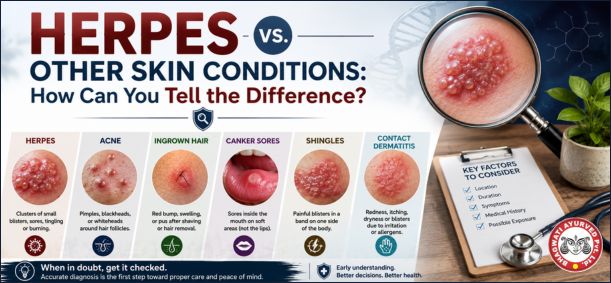
What Does Herpes Usually Look Like?
Herpes simplex can cause clusters of small, fluid-filled blisters that may eventually break, form sores, and heal.
Depending on the type and location of infection, symptoms can occur around:
- The mouth or lips
- Genital areas
- Nearby skin
- Other areas in some circumstances/li>
Some people experience burning, tingling, itching, or discomfort before visible sores appear.
However, symptoms can vary significantly from person to person.
Herpes vs. Acne
Acne is extremely common and can occur anywhere there are hair follicles, including the face, chest, back, and other areas.
Acne may involve:
- Blackheads
- Whiteheads
- Pimples
- Pus-filled spots
- Deeper nodules
Herpes lesions are more commonly described as small grouped blisters that can become painful sores.
Because individual lesions can look different, appearance alone cannot reliably confirm either condition.
Herpes vs. Ingrown Hair
An ingrown hair occurs when a hair curls back into the skin instead of growing normally.
It may cause:
- A small red bump
- Swelling
- Tenderness
- Itching
- Occasionally, pus
Ingrown hairs are particularly common after shaving or hair removal.
A herpes outbreak, on the other hand, may involve multiple small blisters or sores and can be accompanied by tingling or burning.
Herpes vs. Canker Sores
Canker sores occur inside the mouth and are not the same as oral herpes.
Canker sores commonly appear on:
- The inside of the lips
- Inside the cheeks
- The tongue
- Other soft areas inside the mouth
Oral herpes more commonly affects the lips or surrounding skin, although symptoms can vary.
This distinction is important because the two conditions have different causes.
Herpes vs. Shingles
Shingles is caused by the varicella-zoster virus—the same virus responsible for chickenpox.
Although shingles can produce painful blisters, it is different from herpes simplex.
Shingles often appears in a band or concentrated area on one side of the body and may be accompanied by significant nerve pain.
HSV can affect different areas and may recur periodically.
Because both conditions can involve painful blisters, medical evaluation may be necessary when the diagnosis is uncertain.
Herpes vs. Contact Dermatitis
Contact dermatitis occurs when the skin reacts to an irritant or allergen.
Possible symptoms include:
- Redness
- Itching
- Swelling
- Dry or irritated skin
- Blisters in some cases
Unlike herpes, contact dermatitis is generally associated with exposure to something that irritates or triggers the skin.
Why Appearance Alone Isn't Enough
One of the biggest mistakes people make is assuming that a particular-looking sore automatically means herpes.
Skin conditions can overlap in appearance, particularly during their early stages.
Factors such as:
- Location
- Duration
- Previous episodes
- Associated symptoms
- Recent exposure
- Medical history
can all be relevant when determining the possible cause.
For this reason, a healthcare professional may recommend appropriate testing when herpes is suspected.
When Should You Consider Herpes Testing?
Testing may be worth discussing with a healthcare professional if you:
- Have unexplained recurring blisters or sores.
- Develop sores around the mouth or genital area.
- Have symptoms following possible exposure to HSV.
- Have a partner diagnosed with herpes.
- Experience repeated burning or tingling followed by sores.
- Are uncertain about the cause of recurring lesions.
A healthcare professional can determine whether testing is appropriate based on your symptoms and circumstances.
Can Herpes Occur Without Visible Symptoms?
Yes.
Some people with HSV may have no obvious symptoms or may experience very mild symptoms that they mistake for another skin problem.
This is one reason why relying entirely on visible symptoms can be unreliable.
What Should You Avoid Doing?
If you have an unexplained blister or sore, avoid:
- Picking or squeezing the lesion
- Sharing personal items that contact the affected area
- Touching the sore unnecessarily
- Applying random products without knowing the cause
- Assuming the condition is herpes without proper evaluation
Good hygiene and appropriate medical advice are safer than self-diagnosis.
Supporting Overall Skin and Body Wellness
Healthy lifestyle habits can contribute to general well-being.
Consider maintaining:
- A balanced diet
- Adequate hydration
- Regular sleep
- Stress management
- Good personal hygiene
- Appropriate physical activity
At
Bhagwati Ayurved, our wellness approach also emphasizes traditional practices such as balanced routines, mindful living, yoga, meditation, and nutritional awareness.
These practices support general wellness and should not be presented as a substitute for diagnosis or medical treatment.
When to Seek Prompt Medical Attention
Some symptoms require professional evaluation, particularly if:
- A lesion affects or approaches the eye.
- You have severe or rapidly worsening pain.
- You develop widespread sores.
- You have fever or feel significantly unwell.
- You have a weakened immune system.
- You are pregnant and develop possible herpes symptoms.
Do not rely on online images or self-diagnosis in these situations.
How Bhagwati Ayurved Supports Health Education
At
Bhagwati Ayurved, we believe that reliable health information can help people make more informed choices.
Our website provides educational resources covering Ayurveda, herpes, HIV, healthy lifestyle practices, and holistic wellness. Our goal is to encourage readers to understand their health concerns while seeking appropriate professional medical guidance when necessary.
Conclusion
Herpes can sometimes resemble other skin conditions, which is why identifying it based solely on appearance can be difficult.
Acne, ingrown hairs, canker sores, shingles, and contact dermatitis may all produce symptoms that can be confused with herpes in certain circumstances.
If you develop recurring or unexplained sores, speaking with a healthcare professional and discussing whether testing is appropriate is a much safer approach than self-diagnosis.
At
Bhagwati Ayurved, we encourage an informed approach to health—combining awareness, healthy lifestyle practices, traditional wellness principles, and appropriate professional care.